
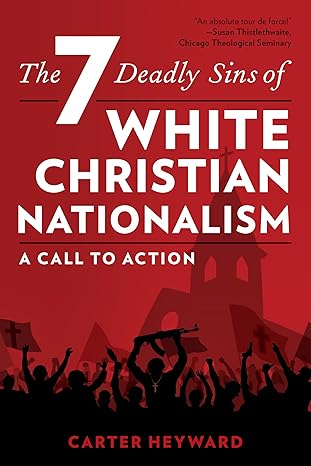
 Because of our concern about the increasing misuse of Christian tradition in support of violence, racism and other evils, the Beloved Community, the Commission on Race and Reconciliation, and the Diocesan Social Justice and Outreach Committee recommend reading Carter Heyward’s book, The Seven Deadly Sins of White Christian Nationalism, and encourage members of the diocese to discuss it. We believe this is the most important issue facing the Church today.
Heyward, one of the Philadelphia Eleven, the first women ordained as Episcopal priests, teaches at Episcopal Theological Seminary; her book is a compelling analysis of how Christian language is being used to promote hatred, and how we can counter structures of injustice and bring healing and love. It is an ideal focus for discussion groups in parishes and beyond.
A recent review begins, “As a professor, theologian, activist, and writer, Heyward has been a pioneer in the areas of feminist liberation theology and the theology of sexuality. In this, her eighteenth book, she takes on the ‘unholy trinity’ of Christianity, capitalism, and the GOP’ by calling for Christian Americans to take on the urgent moral work of confronting religious authoritarianism and speaking out ‘on behalf of a God of justice, love, and peace’
The book is divided into three parts, starting with Heyward’s personal intersection with the roots of what Dorothee Soelle called “christofascism.” She gives an explanation of White Christian Nationalism, tracing its origins, history, spiritual and economic motives, as well as key Supreme Court decisions in the early twenty-first century that shifted the relationship between church and state. These shifts gave legal cover and justification for White Christian Nationalism to take hold.
In part two, she describes the seven deadly sins of White Christian Nationalism: lust for omnipotence, entitlement, white supremacy, misogyny, capitalist spirituality, domination of the earth and its creatures, and violence. Part three counters these deadly sins with seven corresponding calls to action: empowering one another; embodying humility; approaching the blackness of God; empowering women, celebrating sexuality, affirming gender diversity; transforming capitalism; belonging with earth and animals; and breaking the spiral of violence. Each chapter ends with discussion questions, making it an ideal book for discussion group. Heyward’s book is also a powerful source for preaching ideas and could be the basis of a combined book study and sermon series in a congregation.
–Review by the Rev. Dr. Leah D. Schade, Associate Professor of Preaching and Worship, Lexington Theological Seminary
